6/16/2013

Open House, Homemade Crackers


Anthony giving garden tours.
Visitors started arriving at 8:30 a.m., just as we were setting out the lemon balm-lavender lemonade, the homemade crackers and lemon balm cookies. And they kept coming throughout the day, just perfect for us to get to visit with each group and person.
Cricket and Anthony Bongiovani.

This was the last day with us for our intern, Anthony. He's from Pennsylvania and has been with us since April. He has planted a good part of everything growing in the garden this year. So when the first group arrived I asked if he would give the tour. He jumped at the chance and did a great job. He said later he had surprised himself at how many plants he could identify and how much he'd learned while here.

That's Cricket, our pup, who sort of adopted Anthony as her own and the two played together every evening after work.

Anthony had spent the previous couple of days making an assortment of homemade crackers from my book, Easy Homemade Crackers Using Herbs, and lemon balm and lavender cookies, to serve at Open House.

A few of the kinds of homemade crackers Anthony made.

Anthony, having worked at pizza joints in previous years, had a real feel for making crackers and does a better job than I do when I make them.
Lavender and Lemon Balm Cookies.

Visitors came from several surrounding towns as well as from Huntsville, AR, even one couple from El Paso, AZ (although they didn't travel just to see us). Everyone who came were gardeners, and we talked about the new dwarf heirloom tomato, 'Big Purple' from the international Tomato Dwarfing Project.

'Big Purple' dwarf heritage tomato.
One view inside the Herb Shop.

Salvia argentia and daylily bed.
Herb Shop door.
Thanks to everyone who came, including dinner guests, Darcy and Paul, who came to help us celebrate a successful Open House. It was an excellent day. And thank you, Anthony, for all your cheerful help. We wish you the best in your next WWOOFing farm in New Mexico.

6/13/2013

Black Swallowtail Butterflies

Copyright 2013, Jim Long
No reproduction or reposting of this material is allowed without permission of the author.
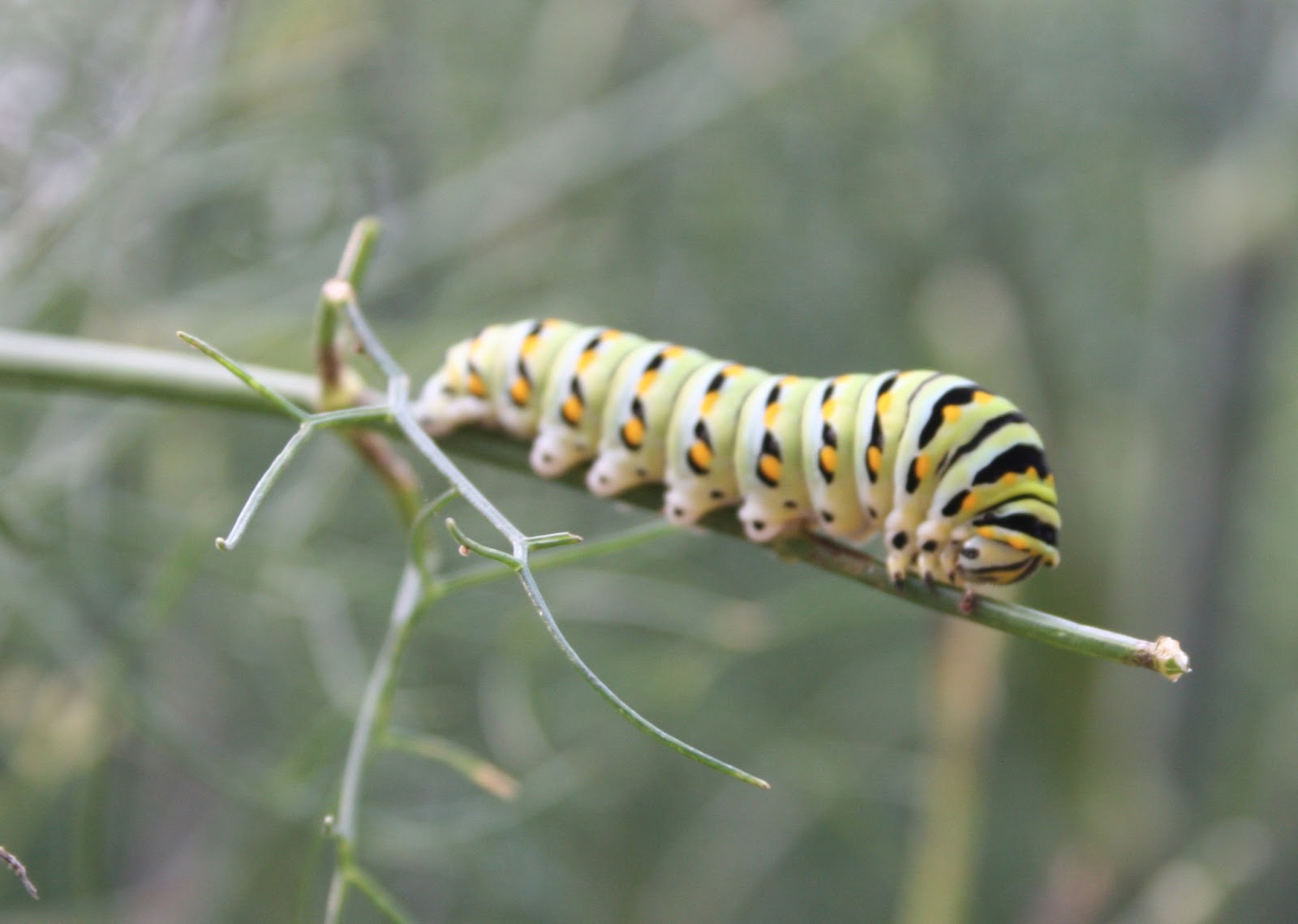
Black swallowtail caterpillar, eating one leaf of fennel.

Black Swallowtail on Butterfly Weed (Asclepias tuberosa)
This is a re-posting of what I wrote about black swallowtail butterflies in 2010 and it's timely today because these colorful caterpillars are appearing in the garden this week.

Butterflies look so slow and docile, gently flitting about the garden. Just get our your camera and try to catch them in their daily duties of sipping nectar out of flowers; you'll quickly see they are shy, move fast and don't like being photographed.

I doubt their eyesight is so great they can see me, but maybe they can. I guess if you're an inch tall and a looming giant, 500 times bigger than you are and carrying a menacing black box with a big moving eye-lens, you might run, too.

Weak, tired and with much of her color worn down, she drank nectar for a day before laying eggs.

Maybe they simply sense a person following them in the garden. After all, their senses must be impeccable, or else they couldn't travel great distances. This Monarch butterfly, above, on the white flowered chives, showed up just as the chives were blooming. As you know, Monarchs spend their winter in South America and manage to navigate northward as the weather warms in spring. This one was worn to a frazzle, weak, but sipping nectar in order to regain her strength for laying eggs for another generation of Monarchs.

A Tiger Swallowtail, dishing up breakfast from dianthus in my edible flower garden.
Most people seem to like butterflies, but many of those same folks have no hesitation for stomping caterpillars. This time of year you'll notice what we always called "dill worms" when I was growing up.
The caterpillar of the Black Swallowtail Butterfly on a fennel leaf.
Black Swallowtail butterflies lay eggs on: fennel, dill, parsley and related plants. Those hatch into the caterpillar you see above. The caterpillar hangs around on one leaf and eats most of it, then pupates, building a little cocoon around itself and hanging there in a little hammock until it has grown. The cocoon splits and out comes the adult Black Swallowtail.
The majestic Black Swallowtail, newly hatched.
An older Black Swallowtail, on oregano.
The list of herbs that attract butterflies is long and extensive. A few you might want to plant if you wish to attract butterflies: Mint, oregano, butterfly weed, Mexican butterfly weed, rue, dill, fennel, parsley, sage, rosemary, thyme, lemon balm, roses, sweet marjoram, hyssop, chives, monarda, yarrow - the list really is quite long.
Monarch caterpillar, see how different they look from the Swallowtail caterpillar?
Monarch caterpillars, however, hang out, sip nectar and lay eggs on butterfly weed (Asclepias tuberosa) which is in bloom right at the time Monarchs are looking for food and home. In case you don't recognize butterfly weed, here's a picture, below. Note that lots of butterflies like the nectar from this plant but it's the Monarch that likes to hang its hat there.

Fritillary butterflies on butterfly weed.
Here in the Ozarks, the butterfly weed is a common roadside plant, starting its bloom around the end of May. This is an old-time medicinal plant, sometimes called, "pleurisy root" because of its use in treating that ailment.

So, if you see, "worms" in your herb plants, let them be, they turn into butterflies or moths and they're not going to ruin your plants. You'll be glad you left them alone when they turn into butterflies! And if you're going to photograph them, well, give yourself more time than you think you will need, they can run faster than you can.

6/07/2013

Herbs and Flowers

Took some time off from garden work to snap a few photos to share with you. The roses have been spectacular. Lots of herbs and flowers are really showing off this week. We're getting ready for our open house June 15, tidying up and finishing the planting.
Valerian flowers.

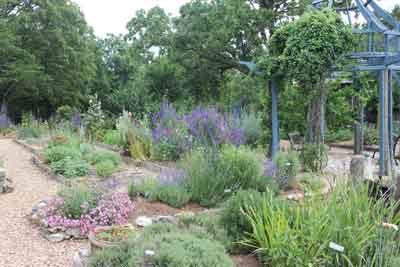
Mostly I stood in one spot and clicked away in various directions. The first one, at left, is the 6 ft. tall valerian plant in the medicinal bed. Valerian, as you may know, is a good natural relaxant and sleep aid.

Yarrow in bloom, beneath the valerian plant.
Medicinal bed on the right, edible flower bed in the center.
The sages, thymes, lavender, poppies, water iris and lots of other herbs are blooming profusely.
Look at those Egyptian walking onions! They look like a crowd of waving hands. Their little bulbils are already putting out more little onions sprouts and in a month, they'll be tipped over to the ground with bulbs on top.
The valerian is a regal plant. This is looking back toward the herb shop porch and bell tower.
Larkspurs, Sweet Williams and Russian salvias are showing off this week but next week the Asiatic lilies will take over for color.
Vines are climbing to the top of the gazebo.
On the left are mostly basil varieties and several oregano plants. On the right is the medicinal bed, mostly native plants and a few non-natives.
And Cricket waiting for someone to throw her favorite flying toy. She spends part of her time hunting lizards, which gratefully, she can't catch yet.
So that's what's happening in the garden today. I hope you will enjoy the views.

5/30/2013

Who Spit on My Plants?

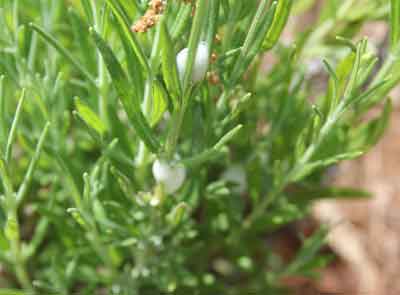
Spittlebug bubbles on lavender stem.

It’s the season for spittlebugs (Cercopidae family). You may see what looks like spit on plant stems but don’t blame it on the neighbor kids or the guy next door. The spittle, or foam, is made by a tiny insect that's so small you will likely never see one. The bug likes lavender, strawberries, salvia, rosemary and a variety of other plants. The spittle is a protective covering for the nymph of this insect. It attaches itself to a plant stem, then secretes a liquid that turns into bubble-like foam, around itself. This foam hides the spittlebug from predators, insulates them from temperature fluctuations and keeps them moist.


Spittlebug eggs are laid in late summer and overwinter on plant debris. The eggs hatch in spring and the young nymphs then crawl up plants and attach themselves, then make their protective covering of “spit.” These insects do little harm to plants. They feed somewhat on the plant’s sap, but unless you have large amounts of these little clumps of spittle, there’s no need to use any kind of poison on them. The easiest control is to use the spray from a garden hose and wash them off the plant with plain water onto the ground, where predators can easily eat them.

The "spit" is a protective coating around the tiny nymph inside.

So don't despair when you see the cluster of bubbles on your lavender or other plants. The spittle is made by a tiny insect to protect itself from birds and other insects. Spray it away with a garden hose and forgive it for looking like spit. Who knows what our house looks like to it?

Happy gardening!

5/22/2013

Garden Full of Life

Caraway thyme in full bloom. Try it in homemade crackers!
I like when my birthday comes because it coincides with all the blooming things in the garden. Yesterday when our ad person from Mother Earth News, Jan Meyers, and her friend, Cheryl were visiting, one of their jobs in the garden was to prune back the taller thyme plants (but not the caraway thyme, which grows close to the ground). (You probably see our ads in Mother Earth News for my Nail Fungus Soak product). When the Orange Spice and Lemon Chiffon thyme plants bloom, it's time to prune them back to prevent die-back. That will keep them producing lots more thyme to harvest rather than letting get scruffy.

Orange Spice and Lemon Chiffon thymes plants after pruning.
Jan pruning thyme, Cheryl watching carefully.
They put lots of the trimmings in brown paper bags to carry back to Kansas in their car. It will dry somewhat on the way and they'll finish drying at home.
Stunning orange iris. Sorry, don't know the name.
This has been probably the best blooming year for iris I can remember in years. In spite of rain and some wind, the irises have held up beautifully.


Anthony tilling fennel bed.
Anthony, our resident WWOOFer, tilled up the last of the empty beds for planting. When this one is finished, the garden will be 95% planted. We're mulching some of the beds but with the recent regular rains, leaving some of the soil exposed to dry a bit.
Little fences don't keep out determined Jack Russels. Molly simply hops over the fence to look for frogs. Cricket checks out the leek bed, below.
Cricket things the hose guard might be a ball.
Chives in full bloom, oregano ready for a haircut in the background.

5/15/2013

Ultimate Plant Support for Container Plants

The Ultimate Plant Cage trellis kit.

If you haven't found this nifty device yet, check it out on the Global Garden Friends website. The Ultimate Plant Cage trellis comes as a kit, with telescoping stakes, expanding as the plant grows. This is perfect for supporting plants in patio pots.
Use it with plants like these Little Prince eggplants, available from Renees Garden. This variety is bred especially for patio pots and planters and you can grow lots of eggplants on your patio.

The Ultimate Plant Cage trellis kit comes with everything you need. The collar goes around the base of the plant, the stakes go into the ground to keep it stable and the expandable stakes (that are attached) can grow with the plant.

Global Garden Friends also makes this amazing little clip for attaching vines, roses, whatever, to any kind of trellis. They easily go around the plant, and snap closed. Better still, they can be reused many times so you don't have to use string or twist-ems.


I've been using the Ultimate Plant Clips on my climbing roses, keeping them tied to the arbor. The way they're attached between your finger and thumb, also protects you from the thorns!

The Ultimate Plant Cage is great for anything you grow in pots that need support and the trellis can be reused, moved, adjusted, many times. It will also work in most any size of planter.


When you go to Global Gardening  Friends website and order the Ultimate Plant Cage, enter the special discount code: jimlong at check-out for a special 25% discount on your order, only for people who follow my blog posts. You will love this great kit for your plants!
Happy gardening!

5/09/2013

Safe, Organic Garden Pest Controls

Anytime I can find a safe control for pests in the garden or yard, I use them. Rather than using a chemical that kills everything, I choose methods that only target a specific pest. Here are some simple pest controls I use.


Packrats and mice in the riding lawnmower: buy a little bottle of mint oil - spearmint or peppermint, and soak a cotton ball. Place it somewhere around the motor and wiring where it will stay put. Rats and mice hate the smell of mint and will stay away. Replace the cotton ball and mint oil every 3-4 weeks. Mint cooking extract works, too, although the smell disappears faster than the mint oil.

Cabbage worms: once the worms start, you can control them with a safe, non-chemical spraying once a week of bacillus (available at garden centers, feed stores). To prevent the worms, make a simple paper barrier early in the year, as soon as you plant cabbage, broccoli, cauliflower or kale. To do that, cut a square of heavy paper or cardboard, about 4 inches by 4 inches square. Make a slit halfway across the square, then slip it around the base of the plant, flat with the ground. Cabbage worms start out as cabbage moths, which lay their eggs at the base of the plants, then they hatch into cabbage worms. By preventing the egg-laying, you are preventing a good many of the worms you would have later.

Soft-bodied insects, such as mites, aphids and mealybugs: Mix 1 tablespoon canola oil and 4 drops of Ivory soap (Ivory works best) into a quart of plain water. Pour into a spray bottle, shake well and spray the leaves of the affected plants both on top and underneath the leaves. 

Mites: mix 2 tablespoons of hot pepper sauce with 5-6 drops Ivory dish soap into a quart of water. Let the mixture stand overnight, pour into a spray bottle, shake well then spray affected plants. Shake container often during application.

Slugs: Little lids of beer placed under the plants that are affected works well. Diatomaceous earth (a natural finely-ground shell) scattered around the plants works on slugs, snails and other soft-bodied insects. The tiny shell particles, called diatoms, work by puncturing the outsides of soft-bodied pests but are not harmful to pets or humans.

Fungal diseases: Mix 2 tablespoons baking soda into a quart of water. Pour into a sprayer bottle and spray affected areas. Repeat application every few days.


Hollyhocks: the bugs that riddle the leaves of hollyhocks can be stopped before they destroy the plant buy using this formula I first learned about from Sharon Lovejoy: combine 1 1/2 teaspoons baking soda, 1 tablespoon canola oil, 1/2 teaspoon dish soap (Ivory works best), 1/2 cup white vinegar in 1 gallon of water. Shake well and pour into a sprayer. Spray the underneath sides of the leaves at the first signs of holes in the lowest leaves. Repeat, spraying underneath all of the leaves each week.

Caution: sprays which kill harmful insects may also kill beneficial insects. Use the homemade formulas selectively, only spraying plants that are infected. Always apply early in the morning or just before dark to avoid bees, butterflies and other beneficial insects. Apply again after a rain. 

Happy gardening!

Copyright May, 2013, Jim Long