7/10/2014

Long Creek Herb Farm Garden on a Rainy Day

The Herb Shop where I sell my books and products when we have tours.

Gazebo and one of the several gates to the garden.

A lightly rainy day in the garden today gives the plants a happy, unusual color. Glad for the rain.
Some of the culinary beds.
A momma bluebird watches me take photos.

Two of the 12 varieties of basil we have this year.
These lilies are wildly fragrant in the late afternoon.
Cool place to sit under the gazebo.
Yard long beans on the left, rose arbor in the distance.
Various pepper varieties in foreground, hardy bananas in the background.
Bountiful crop of muscadine grapes this year.

 My Grandma Long's rocking chair, too worn to still rock.

 That's what our garden looks like on a rainy day.


7/06/2014

Coffee for Roses C.L. Fornari

If you listened to NPR Weekend Edition Sunday (today, July 6), you would have heard Linda Wortheimer's interview with C.L. Fornari about her new book, Coffee for Roses. If you missed it, you can click here to listen to the interview.
Coffee for Roses...and 70 Other Misleading Myths about Backyard Gardening, is a delightfully readable book, packed with delicious surprises. C.L. Fornari is host of the very popular GardenLine radio show on WXTK and describes herself as a true "garden geek."

I met C.L. at our annual Garden Writers Association conference many years ago and have been anticipating her newest book release. This morning, while I ate my breakfast and listened to NPR Weekend Edition Sunday, I had the book beside my coffee and read along as Linda Worthheimer interviewed C.L.

C.L. Fornari

Some of the myths C.L. "busted" in her extensive research, include:
- Rusty nails turn hydrangeas blue (I've heard that all my life)
- Cedar mulch keeps bugs out the garden
- Eggshells prevent blossom end rot on tomatoes (another myth I've long believed; I think I'm disappointed it's not true!)
- Plant red flowers to attract hummingbirds. Research has shown hummingbirds don't care one bit about color, they go where the nectar is. That also means they don't care if the hummingbird feeder is red or purple!
- Marigolds keep bugs out of the vegetable garden. Tests show no benefit from inter-planting marigolds in the garden.
-Don't plant pumpkins near squash because they'll cross-pollinate. I've heard that myth many times, as well as the other silly one, "don't plant fennel and dill together because they'll cross-pollinate." Plants only cross with other plants in the same species.

Not only is this great little book filled with myths busted, but also outstanding information about successfully growing vegetable crops. "When Squash Don't Produce" for example, gives specifics for trouble-shooting your squash plants to find the problem and fix it.

C.L.  Fornari explains why oak leaves and pine needles do not make compost or soil more acidic, and why putting a layer or rocks or broken clay pots in the bottom of pots for drainage is a bad idea.

This is a fabulous book, full of great information and now-dead myths that many of us have held dear for decades. You can order it here and I believe you will be delighted with this highly-entertaining, very educational, downright exciting book!

You can read more about C.L. on her GardenLady website.

6/24/2014

Annual Lobsterfest

I don't know if 2 years in a row makes for an annual event, but as far as I'm concerned, it does. Our friends at Bear Creek Farm - Jim and Robbins Hail, and Wild Goose Gardens - Mike and Susan Jones, along with their garden interns, kids, grandkids and a whole passel of friends and neighbors, once again had a big feast in Mike and Susan's back, front and side yards. Following here are some of the highlights, 52 people including 20 kids, 45 lobsters, 40 ears of corn and more pies, cakes, casseroles, salads and other dishes than anyone could count. The lobsters came from flyinglobsters.com, in case you want to order up a bunch for your own back yard get together.
Propane cookers being fired up by Ed and Josh with Robbins supervising.
Ethan Jones gave tours of his cut flower operation, which looked great.
Josh, Ed and Lonnie checking the water temperatures.
Josh Young giving Lobster 101 demonstration.

While the water heats, Liz attacks a salad.
The kids took to removing the rubber bands on the claws quickly and were good help.
Ed pulling cooked lobsters out of the pots.
Lobsters are ready!
Half of the table of food. Desserts came later.

The food line begins.
Ruan, who works with Ethan, ate his first lobster that day. Seems there aren't lobsters in  Sri Lanka.
Debbie Jones made a lobster pinata, Josh is hanging it up for the kids to hit.
Lobster pinata.
Who better than an attorney to explain the rules of the game!
Children, ready to whack the pinata for candy treats.
But what the day was about, more than lobsters, corn, casseroles, gooseberry, pecan or chocolate pies, or anything else, was an opportunity for friends and families to get together and visit. And there was a lot of that that went on!

5/07/2014

Elephant Rocks and Pickle Springs

Josh and I went on a short trip last week before the Baker Creek Spring Festival, where I was speaking. Our trip took us to Elephant Rocks State Park, Johnson Shut-Ins, Mammoth State Park and Pickle Springs Nature Preserve. At Pickle Springs we found a colony of unidentified plants (below). Funny, I can pass a dozen people on the street and not feel I need to know everyone's names, but when I cross paths with a plant I don't know, I just have to find the name. Now I know, these are American Colombo (Frasera spp.).
American columbo - Frasera caroliniensis
Perfect time to walk in the woods, so many wildflowers, mushrooms and trees in bloom.
Stream from Pickle Springs
Elephant rocks, atop the mountain, amazing.
One of many "kissing rocks" at Pickle Springs
Rattlesnake orchid, a plant which doesn't grow where I live.
"Fat man's trap", I was glad I could pass through easily.
Ferns at the base of the rocks, I just love seeing these in spring!
Even though our morel season is over in the Ozarks, they were still finding them up near St. Louis.
I always think of my mother when I see dogwoods in bloom.
Turtles sunning themselves in the old quarry at Elephant Rocks.
What amazing things nature creates!

4/24/2014

Artemisia - Herb of the Year 2014

Copyright, 2014 Jim Long
The official Herb of the Year for 2014 is Artemisia, which encompasses a large and diverse family of plants. Probably the best-known Artemisia relative is French Tarragon, which a decade ago was on the list of the top 10 most-purchased plants in the U.S. (It has fallen off the top ten list, replaced a few yeas back in popularity and sales, by cilantro; to read more about the Top Ten Most Popular Herbs, from my nationwide survey, read my book by that title, click here for info).
French Tarragon (Artemisia dracunculus 'Sativa')
Another in this family of plants is absinthe (Artemisia absinthium), best known for the anise-flavored beverage, Absinthe. The spirit once had a bad reputation, mistakenly for the belief the ingredients could cause mental illness. It had great popularity as an alcoholic drink in the late 1800s, especially among writers and artists in France. Prohibitionists portrayed it as a dangerous and addictive drug and Absinthe was banned. Current studies have shown absinthe's properties were greatly exaggerated, and it was the over-consumption of alcohol, not the plant chemicals (thujones) present, that caused the problems. Absinthe is now manufactured by a variety of companies in both Europe and America. The plant itself is easy to grow and quite attractive.
Artemisia absinthium
With delightful gray-green leaves, the plant reaches to about 3 ft. in height and makes an excellent background or foliage plant in the landscape.
Leaves of the absinthe plant.
Yet another member of the Artemisia family is mugwort, (Artemisia vulgaris). It is seldom if ever used as a culinary herb, but its reputation in dream blends is well know. I use it in my own dream pillow formulas because it has been shown to help a person remember their dreams. (To read more, visit my Dream Pillows page of my website, or go to my Dream Pillows blog for stories about Dream Pillow use for quieting nightmares).
Mugwort (Artemisia vulgaris).
Upon first glance, Mugwort and Absinthe might look very similar but if you look closely, you'll see the leaves of Absinthe are more rounded and gray on top and bottom. Mugwort, by contrast, has pointed ends of the leaves and is green on top and gray on the underneath side. Another difference is Mugwort is invasive like mint, while Absinthe stays put as one plant much better.

To learn more about the Herb of the Year, visit the International Herb Association's website, click here.

4/17/2014

Morels

I'm not alone in thinking "will spring ever come?" Friends in Minnesota told me they had 10 inches of snow this week. I mistakenly bragged slightly we'd had our first asparagus and morel mushrooms. The next day (3 days back) it was spitting snow and raining here and we got down to freezing. My shipment of hot pepper plants arrives tomorrow and I'm not even close to having the garden ready! But there are some encouraging signs.
It's a small handful, but still we take encouragement where we can find it!
These are just the early morels, the early white ones. The larger yellow morels will be coming up soon. Where do I find them? Primarily under elm, red oak and ash trees. But also under cedars and even a couple of times, in the gravel edge of road pavement (near an elm tree).
You have to look close to find morels.
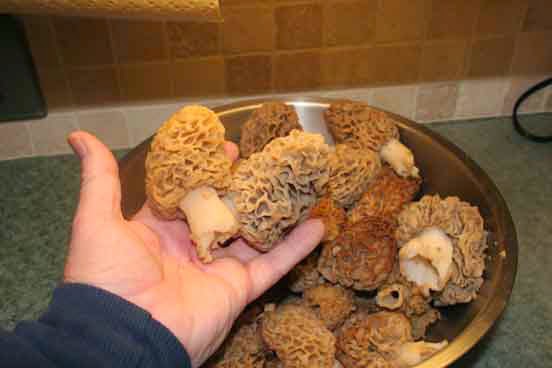
But it's worth it when you find a bunch.

We had guests on Sunday and I served them tulips stuffed with chicken salad, deviled eggs, corn pudding, some of Josh's homemade sourdough bread, and a few morels for each of us. What I'd call, a perfect spring dinner. So there is hope that spring will eventually arrive and the cold will leave us for this season.
Happy spring!