6/24/2014

Annual Lobsterfest

I don't know if 2 years in a row makes for an annual event, but as far as I'm concerned, it does. Our friends at Bear Creek Farm - Jim and Robbins Hail, and Wild Goose Gardens - Mike and Susan Jones, along with their garden interns, kids, grandkids and a whole passel of friends and neighbors, once again had a big feast in Mike and Susan's back, front and side yards. Following here are some of the highlights, 52 people including 20 kids, 45 lobsters, 40 ears of corn and more pies, cakes, casseroles, salads and other dishes than anyone could count. The lobsters came from flyinglobsters.com, in case you want to order up a bunch for your own back yard get together.
Propane cookers being fired up by Ed and Josh with Robbins supervising.
Ethan Jones gave tours of his cut flower operation, which looked great.
Josh, Ed and Lonnie checking the water temperatures.
Josh Young giving Lobster 101 demonstration.

While the water heats, Liz attacks a salad.
The kids took to removing the rubber bands on the claws quickly and were good help.
Ed pulling cooked lobsters out of the pots.
Lobsters are ready!
Half of the table of food. Desserts came later.

The food line begins.
Ruan, who works with Ethan, ate his first lobster that day. Seems there aren't lobsters in  Sri Lanka.
Debbie Jones made a lobster pinata, Josh is hanging it up for the kids to hit.
Lobster pinata.
Who better than an attorney to explain the rules of the game!
Children, ready to whack the pinata for candy treats.
But what the day was about, more than lobsters, corn, casseroles, gooseberry, pecan or chocolate pies, or anything else, was an opportunity for friends and families to get together and visit. And there was a lot of that that went on!

5/07/2014

Elephant Rocks and Pickle Springs

Josh and I went on a short trip last week before the Baker Creek Spring Festival, where I was speaking. Our trip took us to Elephant Rocks State Park, Johnson Shut-Ins, Mammoth State Park and Pickle Springs Nature Preserve. At Pickle Springs we found a colony of unidentified plants (below). Funny, I can pass a dozen people on the street and not feel I need to know everyone's names, but when I cross paths with a plant I don't know, I just have to find the name. Now I know, these are American Colombo (Frasera spp.).
American columbo - Frasera caroliniensis
Perfect time to walk in the woods, so many wildflowers, mushrooms and trees in bloom.
Stream from Pickle Springs
Elephant rocks, atop the mountain, amazing.
One of many "kissing rocks" at Pickle Springs
Rattlesnake orchid, a plant which doesn't grow where I live.
"Fat man's trap", I was glad I could pass through easily.
Ferns at the base of the rocks, I just love seeing these in spring!
Even though our morel season is over in the Ozarks, they were still finding them up near St. Louis.
I always think of my mother when I see dogwoods in bloom.
Turtles sunning themselves in the old quarry at Elephant Rocks.
What amazing things nature creates!

4/24/2014

Artemisia - Herb of the Year 2014

Copyright, 2014 Jim Long
The official Herb of the Year for 2014 is Artemisia, which encompasses a large and diverse family of plants. Probably the best-known Artemisia relative is French Tarragon, which a decade ago was on the list of the top 10 most-purchased plants in the U.S. (It has fallen off the top ten list, replaced a few yeas back in popularity and sales, by cilantro; to read more about the Top Ten Most Popular Herbs, from my nationwide survey, read my book by that title, click here for info).
French Tarragon (Artemisia dracunculus 'Sativa')
Another in this family of plants is absinthe (Artemisia absinthium), best known for the anise-flavored beverage, Absinthe. The spirit once had a bad reputation, mistakenly for the belief the ingredients could cause mental illness. It had great popularity as an alcoholic drink in the late 1800s, especially among writers and artists in France. Prohibitionists portrayed it as a dangerous and addictive drug and Absinthe was banned. Current studies have shown absinthe's properties were greatly exaggerated, and it was the over-consumption of alcohol, not the plant chemicals (thujones) present, that caused the problems. Absinthe is now manufactured by a variety of companies in both Europe and America. The plant itself is easy to grow and quite attractive.
Artemisia absinthium
With delightful gray-green leaves, the plant reaches to about 3 ft. in height and makes an excellent background or foliage plant in the landscape.
Leaves of the absinthe plant.
Yet another member of the Artemisia family is mugwort, (Artemisia vulgaris). It is seldom if ever used as a culinary herb, but its reputation in dream blends is well know. I use it in my own dream pillow formulas because it has been shown to help a person remember their dreams. (To read more, visit my Dream Pillows page of my website, or go to my Dream Pillows blog for stories about Dream Pillow use for quieting nightmares).
Mugwort (Artemisia vulgaris).
Upon first glance, Mugwort and Absinthe might look very similar but if you look closely, you'll see the leaves of Absinthe are more rounded and gray on top and bottom. Mugwort, by contrast, has pointed ends of the leaves and is green on top and gray on the underneath side. Another difference is Mugwort is invasive like mint, while Absinthe stays put as one plant much better.

To learn more about the Herb of the Year, visit the International Herb Association's website, click here.

4/17/2014

Morels

I'm not alone in thinking "will spring ever come?" Friends in Minnesota told me they had 10 inches of snow this week. I mistakenly bragged slightly we'd had our first asparagus and morel mushrooms. The next day (3 days back) it was spitting snow and raining here and we got down to freezing. My shipment of hot pepper plants arrives tomorrow and I'm not even close to having the garden ready! But there are some encouraging signs.
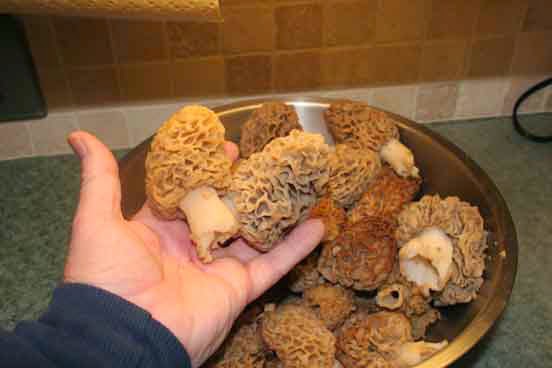
It's a small handful, but still we take encouragement where we can find it!
These are just the early morels, the early white ones. The larger yellow morels will be coming up soon. Where do I find them? Primarily under elm, red oak and ash trees. But also under cedars and even a couple of times, in the gravel edge of road pavement (near an elm tree).
You have to look close to find morels.
But it's worth it when you find a bunch.

We had guests on Sunday and I served them tulips stuffed with chicken salad, deviled eggs, corn pudding, some of Josh's homemade sourdough bread, and a few morels for each of us. What I'd call, a perfect spring dinner. So there is hope that spring will eventually arrive and the cold will leave us for this season.
Happy spring!

3/29/2014

Hardy Rosemary - Arp


Arp and Hill Hardy rosemary

I've long wondered how 'Arp' rosemary got its name, and I admit I always thought it an odd choice for a plant name. While visiting Festival Hill a couple of years ago, I was pleased to share breakfast with Gwen Barclay and Henry Flowers. Gwen, as many of you may remember, is the daughter of the late Madalene Hill (whose incredible rosemary collection resides at Festival Hill). Henry Flowers it the horticulturalist and over-all plant genius at Festival Hill and began his work under Madalene's supervision. (If you want to know more, you can read the tribute I wrote about Madalene on my earlier blog, here.
Henry Flowers, Horticulturist at Festival Hill

Gwen Barclay, chef, musician and herbalist.

Gwen made a reference to Arp rosemary, how there were a lot of the plants sold during the plant sale that weekend and that the Herb Society of America was intending to plant a commemorative plaque in Arp.

"You mean Arp is a place?" I asked.

So I got the whole story, directly from Gwen and Henry.

Gwen and her mother have cousins in Arp, Texas, southeast of Tyler. One Christmas they were visiting their cousins and Madalene noticed a very robust rosemary, in full bloom, in front of an abandoned house nearby. It was unusual for a rosemary to be covered with blue-lavender flowers at Christmas time. Madalene inquired of her cousins and the neighbors if anyone knew who owned the old, neglected (and empty) house. No one knew anything about the owner.

Madalene borrowed a knife and made several cuttings from the very prolific rosemary and took them home with her to root. Over the next few years she shared the cuttings with several people, including the late Tom DeBaggio. He began propagating the now named, 'Arp' rosemary for his retail nursery. (You can read more about Tom and his amazing story of dealing with Alzheimer's disease on his nursery website here; you will also find lots of stories about him on National Public Radio, the Washington Post, etc. if you Google his name).


Hill Hardy rosemary

One day Tom noticed that one rosemary stood out as different from among the dozens of trays of Arp rosemary cuttings and he separated it out and grew it on, propagating more. That rosemary was more gray and fine-leafed than the Arp rosemary which appeared to be its parent. Over time Tom discovered the grayer rosemary to be equally or even more hardy than the original Arp, and he dubbed it, 'Hill's Hardy' rosemary, in honor of Madalene Hill who had first brought it to him.

Thanks to my Garmin navigator, Arp wasn't difficult to find.

Since I had Arp rosemary with me, and now knew the real story of the origins of both these exceptional rosemaries, and since I was already heading toward Tyler, TX from Round Top/Festival Hill, I decided I should definitely drive to Arp, TX and see where this amazing rosemary came from.
That's my pot of 'Arp' rosemary, standing proudly in front of the Arp welcome sign.

(Madalene had found, in later years, the name of owner of the property, and learned the rosemary had come to Arp from "somewhere up in Oklahoma," but no one knew anything else about its origins). The Herb Society of America is slated to erect the plaque in Arp, sometime this coming summer.

That's 'Arp' on the left, 'Hill Hardy' on the right. Some nurseries list 'Hill Hardy' as 'Hill's Hardy' rosemary, which I believe is correct. Both are outstanding rosemaries to grow and use.
 So there is the story of the origins of a this particularly good, and hardy rosemary and it's cousin, 'Hill Hardy.' The rosemary itself is likely more famous than the little town it came from, but you can't miss the sign if you drive through.

This year, however, with the deep and prolonged cold (3 degrees for us in December and January) even my Arp rosemary has been killed. It's been tough, lasting for several years but this was a record-breaking cold with more snow than I can remember in my lifetime. I'll have to start over with some new rosemarys.

3/13/2014

Help Kids Gardening By Ordering Seed

A few of the 500 kids in one of their 3 gardens at school.
I've posted this before but thought a reminder would be in order since it's seed-ordering season. If you are going to order garden seed, consider ordering some of your seed through my website. On my home page, scroll down to the bottom and on the left you'll see this button:
We raised $465 from Renee Shepherd, from people who ordered her seed through our website, all of that money going directly to the kids' garden project. Thank you to all who ordered!
 
Kids gardening is important! When kids learn how to grow plants, learn where their food comes from and how to prepare healthy meals, they learn skills that will stay with them for their entire life. I've written about the amazing kids' garden project at the magnet school in Jonesboro, Arkansas, several times before. (Click here to see an earlier post and more photos). And here for the story about cooking with the kids in their amazing kitchen. But I thought you might like a reminder that this project is always struggling to find enough money for seed, soil and other supplies the kids need.


Learning to weed and identify the edible plants.
We've had the button on our website, "Buy Seed, Help Kids," for the past 3 years to encourage readers to order and help the kids. It's a project whereby you can order garden seed from Reneesgarden.com, for your own garden, and Renee Shepherd generously donates 25% of the revenue from your order, back to the school! It's a wonderful project. If you go to our website, LongCreekHerbs.com, here's the button you will see on the left side:


When you click on that, you are directed to a page with a code to enter when you place your order at Renee's Garden Seed You can order seed for your spring garden and when you order, it will count toward a donation for the kids' garden project, and you will receive outstanding seed.


Renee Shepherd, owner reneesgarden.com
Renee Shepherd donates to a wide variety of children's garden projects, both in the United States and in other countries. That's why we are so pleased to partner with her in helping this garden in Jonesboro, Arkansas. If you have not visited her website, please do so, her seed selections are outstanding and I grow many in my gardens each season. (AND... if you like wasabi flavor, consider her very tasty and easy to grow Wasabi Arugula! I don't like arugula much, but I love the wasabi variety).


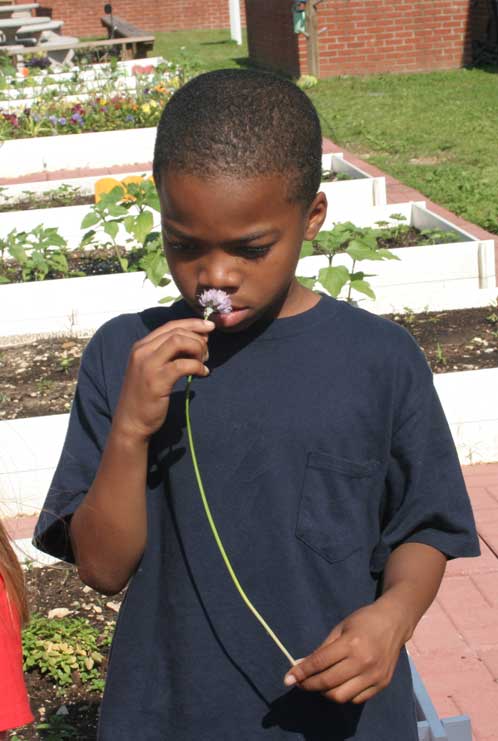
To visit Renee's Garden website, go to our website at Long Creek Herbs, and click on the Help Children- Seeds button.  You'll find the link to Renee's Seeds website, look around and see if you aren't tempted by her spring seed offerings. Then when you order, use our code (it's in the instructions you'll see), so that she can make a donation to this wonderful project. Then, you will know that more kids, like this boy, below, can experience for the first time in their life, the taste and smell of a chive blossom and learn how to fix a meal using fresh herbs and vegetables right out of the garden.
I hope you'll consider ordering seed from Renee Shepherd, she has outstanding varieties you won't find anywhere else. And when you order, won't you do it through my website so the kids get credit? Thank you!


This was his first time smelling or tasting chives!