2/28/2014

Mint is Trendy Again

Mentha spicata 'Blue Eye'
 Mint (Mentha spp.) is reported to be making a huge comeback this year, according to the Specialty Food Association’s 39th Winter Fancy Food Show last month in San Francisco. This old-time favorite herb evokes familiar, comfort-flavors of the American palate. Silk Road Soda, a West Coast premium beverage company introduced a line of mint sodas at the show, including cucumber-mint and pomegranate mint and a line of new mint and licorice almond water and hibiscus-mint frozen pops was introduced, as well.


Bar owners have realized that all ice isn’t the same. Commercial ice, as well as ice out of the ice machines, contains air and minerals. Ice with air melts faster and the minerals change the flavor of the drink. Many high-end establishments now have full-fledged “Ice programs” which produce ice for their cocktails that are better tasting, more attractive and, yes, worthier of premium prices.

According to Nation’s Restaurant News, bartenders at Trump International Hotel create house-made cubes formed in pastry molds and blast-frozen and include such items as rose petals with raspberry, elderflower, mint, basil, lemon verbena and others. Their signature drink this year is the Opulence 5, which is a medley of Champagne, artisan vodka, elderflower liqueur served over five different herb-flavored cubes which slowly melt, adding new layers of flavor. It can be added to your tab for a mere $55.
Mint 'Berries and Cream'
So is there anything new with mints? You bet there is! Jim Westerfield, in Illinois, has been crossing and re-crossing mints for years. His mints are on the "hot" list for chefs and bar owners. One of my favorites is his 'Berries and Cream' (Mentha 'Berries and Cream') which has a wonderful fruity flavor with a smooth, creamy background.
Mint 'Fruit Salad'
Another of the Westerfield patented mints is 'Fruit Salad' mint. It is a variety of spearmint (Mentha spicata) and has a unique, very pleasant fruity flavor. You'll also find Margarita mint, with a zippy lime background flavor that is perfect for beverages.

All of the Westefield new patented mints can be found only at Richters Herbs. You can find these amazing trendy new mints on-line and Richters has an exclusive contract for these exciting new mints.

And that mint I posted at the top of the page, Mint 'Blue Eye'? That's one I discovered growing beside a woodland spring near Blue Eye, Missouri, 34 years ago. It's an especially good tasting mint and withstands more frost than most. In the fall, at the first frost, I like walking in the garden and picking the frost-covered leaves of this mint for a cool, minty flavor. 'Blue Eye' mint can be gotten from Mountain Valley Growers where my friend, V. J. Billings is growing my mint for sale.

2/17/2014

Cumin Scented Perilla

Another up-and-coming chef herb this year is perilla or shiso. The two more common varieties of perilla (Perilla frutescens) grow wild across the Ozarks region of Southern Missouri, including my garden. Both of these, the red and the green leaf varieties escaped from cultivation decades ago. Both can be found growing wild along roadsides and edges of fields in many places. Visitors to my garden have told me they thought it was wild basil, although it isn't remotely related to that plant. Both the red and green are simply Perilla frutescens, also known as shiso, but both of these plants are quite strong flavored and not as desirable in cooking as the Vietnamese perilla (Perilla frutescens var crispa). Of course that's my opinion, both the red and green varieties are used in Korean, Japanese, Chinese and other Asian cuisines, both as an ingredient and as a coloring agent.
Stronger flavored, this perilla grows wild in many parts of the U.S.
But it is the cumin-scented perilla (not the one above) that I think has the better flavor and culinary uses. I found mine in a plant market near Tampa, Florida this past month. I've had starts before from a friend in Illinois but lost them to frost and hadn't collected any seeds.
Cumin scented perilla
The plant varies from green, to green on top and red underneath the leaves, as in the one above. As Tom DeBaggio and Dr. Art Tucker said in The Encyclopedia of Herbs: A Comprehensive Reference, "the application of the cultivar names is poorly defined in the literature. Many different scents of the beefsteak plant also exist." In other words, there are variations of scents in shiso (sometimes called beefsteak plant, mostly for the red-leaf varieties, so choosing the best fragrance and flavor is a mater of choice).
It's an attractive addition to the herb garden.
Both the red and green varieties often called beefsteak plant due to the red of the leaves, is used in pickling in Japanese dishes. The green-leaf variety known as "Tia To" is milder and has the pleasant cumin scent and flavor. Other cultivars available include ‘Atropurpurea’ with dark purple leaves; ‘Crispa’ with crinkled bright purple or bronze leaves mottled with green or pink and ‘Laciniata’ with all-green, deeply incised leaves. Varieties 'Green Cumin' and 'Purple Cumin,' both readily available, have cumin-and cinnamon-scented leaves. 'Aojiso' has green ginger-scented leaves, often used with sashimi. 'Red' or 'Akajiso' has rich, deep red to purple leaves. The large-leafed 'Kkaennip' or Korean perilla is used in a variety of ways.

The leaves are used as a wrap in sushi, shredded on salads, mixed in Mesclun salad mixes, sprinkled over cucumbers, cabbage or fish dishes. Try the fresh leaves thinly shredded on a fish taco!
 Try this perilla pesto served over pasta, fish or mixed with sour cream as a dip for vegetables.

Perilla Pesto
1/2 cup toasted almonds
3 garlic cloves
1/3 cup olive oil
2 cups fresh cumin-scented perilla leaves, torn in pieces
Juice of 1 fresh lime
1/2 teaspoon salt

In a food processor, coarsely chop the almonds, the add the remaining ingredients and pulse-chop until you have a spreadable pesto. This can be stored in the refrigerator, covered, for about 24 hours.

Seed for cumin-scented perilla aren't easily to find. I found only 2 companies that carry it:
Kitazawa Seed Co.
and One-Garden, Inc.

When growing any perilla, be aware it will reseed itself. The cumin-scented one isn't prone to that and I've never had a volunteer plant come up in the garden. But the common red and green curly leaf ones that grow wild, can become a weed if you don't clip out the flowering tops before fall. Even then it's not an unpleasant plant to find in the garden and is easily controlled by mulching over it.

2/09/2014

Papalo Hits the Big Time

Recently I've been working on a couple of magazine assignments about the hot new herbs and plants for 2014 for restaurants. My research started with new restaurant trends on-line, then I've been concentrating on interviews with chefs around the country. Not surprisingly, locally sourced produce is even bigger this year than last, new introductions of non-wheat pasta and noodles, sustainable seafood and children's menus in upscale restaurants are a few of the items.
Papalo, growing on mature plant.

One hot new herb that surprised me a bit for this year is papalo (Porophyllum macrocephalum), sometimes commonly dubbed "Buzzard's Breath" (although I'm guessing there won't be any chefs across the U.S. who will use that name; let's see, how might that sound on a menu..... farm-raised pork cemitas with seasonal chilies and buzzard's breath sauce...)

Used like cilantro in Bolivia, where my original seed start came from, as well in some states in Mexico, it's easy to see (or smell) why it got dubbed buzzard's breath. Just getting near the plant you'll get a whiff of something akin to aluminum with lemony overtones with some rue and other smells thrown in. That's on the mature plant, which isn't the stage of the plant normally used. The flavor has been described as something like a combination of arugula, mint and cilantro, although that doesn't quite describe it, either. The flavor is unique to the plant.
Cemitas, a Mexican sandwich.

Papalo is also commonly eaten raw on cemitas - sometimes known as a cemita poblana, which is a Mexican sandwich and street food that originated in the city of Puebla. Papalo is also sometimes found in guacamole and in Mexico it is used fresh in soups and stews. In Bolivia native Quechua people call it Killi and eat it daily just torn up onto foods. (If you use the search button on my blog for papalo, to the right, you can find more that I've written about this interesting herb).

Papalo sold as young, pulled seedlings in Acalpulco markets.

Papalo is showing up in gardens from California to New York City, and in markets with large Hispanic populations. However, a lot of Hispanics from other parts of Mexico or South America may not know the plant at all. I found it in the markets in Acalpulco when I visited there a few years back and admit I didn't understand the plant at all until then. I'd always let mine get to 3 or 4 feet tall and found the flavor of the leaves unpleasant. But in the markets of Acalpulco I discovered it was being grown as seedlings, the whole plant pulled up at about 12 to 15 inches tall, and the flavor of the plant was vastly better than from the mature plant.

Vendor in Mexico selling papalo.
Even though regular cilantro (Coriandrum sativum) is used extensively in Mexican cooking, that herb is not native to anywhere in the Americas (it is native to the eastern Mediterranean). But Papalo is native to the Americas and can be found growing wild from Bolivia northward as far as the southern U.S.

Here's a simple recipe to try when you're learning the flavors of this ancient herb. It's a simple green sauce and if you travel in Mexico, you may encounter the sauce used on eggs, sandwiches or other dishes.

8 green tomatillos, diced
1 green onion, diced
2 cloves garlic, whole
1 serrano or jalapeno chile, stem and seeds removed
4 or 5 fresh papalo leaves
1 large or 2 small avocados, diced
2 teaspoons olive oil

In a small skillet, combine the oil, tomatillos, onion, garlic and chile and simmer on medium heat until the tomatillos are soft, about 10 minutes.
Pour the ingredients into a food processor, along with the papalo leaves (I sometimes add juice of 1/2 lime, too) and pulse blend until everything is chunky-smooth.
Pour into a bowl and add the diced avocado. Let stand for about 30 minutes for flavors to blend well. Serve with chips or as a sauce on your favorite morning egg dish.

The following companies offer papalo seed:
Nichols Garden Nursery
Southern Exposure Seeds
Johnny's Selected Seeds


1/29/2014

All-America Selections for 2014

All-America Selections
Announces
Additional Winners 


DOWNERS GROVE, IL – January 28, 2014

Just in time for the 2014 gardening season, All-America Selections (AAS) is pleased to present eight more AAS Winners that proved themselves to be superior garden performers. With the addition of these eight winners, we have a grand total of nineteen winners for the 2014 gardening season, the most AAS Winners announced in one year since the first winners were announced in our first decade of existence in the 30’s and 40’s.

Both growers and retailers will want to offer the following National and Regional Winners to fulfill customer requests.

The four newest Regional Winners are:
Cucumber Saladmore Bush F1
Eggplant Patio Baby F1
Pepper Giant Ristra F1
Radish Rivoli

The four newest National Winners are:
Angelonia Serenita™ Pink F1
Impatiens, New Guinea Florific™ Sweet Orange F1
Ornamental Pepper NuMex Easter
Osteospermum Akila(R) Daisy White F1

A seed source list for those wishing to purchase recent AAS Winner seeds can be found here:  (Please allow several weeks for seed sources of the AAS Winners in this announcement to appear.) 
A complete list of trial grounds and judges can be found here:

A list of all AAS Winners since 1932 can be found here and is now sortable by National or Regional Winners.
Cucumber Saladmore Bush F1
AAS Regional Edible Winner
(Southeast)


Saladmore Cucumber boasts a bush-type growth habit making this AAS Winner perfect for growing in container gardens. Anyone looking for a good slicing type cucumber with dark green skin and long straight fruits will enjoy this beauty, along with its superior taste and texture; a perfect reflection of summer’s bounty. An added bonus is the disease resistance that proved to be especially valuable in warmer climates where comparison varieties easily succumbed to late season diseases.

Bred by Seeds By Design
Eggplant Patio Baby F1
AAS Regional Edible Winner 
(Northeast)


Two things judge after judge brought up about this eggplant: 1) This entry produced such an attractive plant that it could be used as both an ornamental and an edible and 2) It is a perfect plant for container gardens. Patio Baby is indeed compact at less than 24” mature height, and yet it produces a prolific number of small 2-3” teardrop shaped glossy purple-black fruits. And of course, taste is a top priority in the AAS Trials and judges agreed that the taste was excellent, noting it was less bitter than the comparison varieties. Several northern judges were extremely pleased that Patio Baby grew so well in their conditions and was earlier to harvest by about a week, which is important when the gardening season is shorter.

Bred by PanAmerican Seed
Pepper Giant Ristra F1
AAS Regional Edible Winner 
(Mountain/Southwest)


Talk about versatility! Giant Ristra looks like a red Marconi pepper but has the heat of a cayenne. The texture and heat (hot, but not too hot) of this pepper makes it an excellent eating variety while it can also be dried and used in dishes for up to one year. Should you choose to use the peppers for a decoration, they can be used to make a beautiful ristra of dried peppers. 
In the mountain and southern trial gardens, Ristra produced an exceptionally high yield of uniformly shaped peppers on attractive plants which judges reported were very easy to grow.
 
Bred by Seeds By Design
Radish Rivoli
AAS Regional Edible Winner 
(Southeast, Heartland, West/Northwest)

Rivoli earned the judges’ favor by producing a very large, uniformly-sized root with a bright red exterior and an exceptionally smooth, clear white interior. Unique to most radishes, Rivoli holds well and does not get pithy or woody, even under stress. All these attributes combined mean a tasty, sweet, crisp radish that also matures earlier than the comparisons. A helpful tip from the AAS judges is to space Rivoli further apart than normal radishes since roots are much larger.
 
Bred by North Carolina State University, produced by Bejo Seeds
Angelonia Serenita Pink F1
AAS National Flower Winner


Serenita is a compact, tough little angelonia ideal for very hot/humid temperatures like in southern areas but it does great in northern gardens too. This Serenita variety features a unique deep pink flower, not usually seen in angelonias. The AAS Judges praised this entry for being drought and heat-tolerant while continuing to produce a large number of flowers all season long.

Commercial growers should note that this is a new color for the Serenita series that require fewer PGRs to produce plants that are 2” shorter in the greenhouse, and can be up to 5” shorter in the garden.
 
Bred by PanAmerican Seed
Impatiens New Guinea Florific Sweet Orange F1
AAS National Bedding Plant Winner


Huge 2” blooms in beautiful shades of light orange against dark green foliage create a giant impact in the garden, especially in shade or semi-shaded areas where color is needed. The natural disease tolerance of a New Guinea Impatiens is a welcome addition to a plant that boasts such beautiful flowers on a compact plant perfect for small space gardens.

Commercial growers now have an alternative to vegetative New Guinea Impatiens and one that needs fewer PGRs to keep this beauty compact and tidy.

Bred by Syngenta Flowers
Ornamental Pepper NuMex Easter
AAS National Bedding Plant Winner


You know the AAS judges were impressed when the scores sheets read like this: “Exceptional plant. Love this little pepper! Striking color! Eye-catching! So easy to grow! Loaded with pepper fruits in fun colors. A favorite of garden visitors!” NuMex Easter is a very compact plant, growing to only 6” high but packs quite a punch in such a small package. Beautiful purple, yellow and orange conical fruits pop up above the foliage for a great display of color.

Commercial growers will appreciate the shorter crop time for NuMex which results in earlier blooms on a very compact, well-branched and uniform plant with fantastic fruit coloration. Judges familiar with the bedding plant market think this is the first real ornamental pepper for bedding plant growers.
 
Bred by The Chili Pepper Institute at New Mexico State University
Osteospermum Akila(R) Daisy White  F1
AAS National Bedding Plant Winner


White osteospermums are not unique but a clear white osteo with a yellow center is a novelty, plus, it’s easily grown from seed. Akila® Daisy White is a tidy, uniform plant with open flowers that produces non-stop blooms all summer long. Even southern judges praised Akila’s ability to keep blooming in the heat and they also showed more drought tolerance than other osteos.

Daisy White is part of the Akila series and boasts the same great greenhouse performance as the other colors in the series, none of which need pinching or vernalization.
 
Bred by PanAmerican Seed
Other recently announced AAS Winners:

National Winners:                                                                    Regional Winners:

Petunia African Sunset F1                    Sunflower Suntastic Yellow with Black Center
Pepper Mama Mia Gaillo F1                                          Cucumber Pick-A-Bushel F1
Tomato Chef's Choice Orange F1                             Penstemon Arabesque Red F1
Tomato Fantastico F1                                           Pumpkin Cinderella's Carriage F1
Gaura Sparkle White                                                         Tomato Mountain Merit F1
Bean Mascotte
Zinnia Profusion Double Hot Cherry
Zinnia Profusion Double Deep Salmon 

1/14/2014

Renees Garden Seed Helps Kids Gardens

A few of the 500 kids in one of their 3 gardens at school.


Kids gardening is important! When kids learn how to grow plants, learn where their food comes from and how to prepare healthy meals, they learn skills that will stay with them for their entire life. I've written about the amazing kids' garden project at the magnet school in Jonesboro, Arkansas, several times before. (Click here to see an earlier post and more photos). And here for the story about cooking with the kids in their amazing kitchen. But I thought you might like a reminder that this project is always struggling to find enough money for seed, soil and other supplies the kids need.


Learning to weed and identify the edible plants.
For 3 years we've had a button on our website, "Buy Seed, Help Kids." It's a project whereby you can order garden seed from Reneesgarden.com, for your own garden, and Renee Shepherd generously donates 25% of the revenue from your order, back to the school! It's a wonderful project. Unfortunately we only raise about $25 a year for the school. I don't know if people don't find the link, or don't want to order seed, but if you go to our website, LongCreekHerbs.com; here's the button you will see on the left side:


The lower left corner on our home page has the Help Children-Buy Seeds button. When you click on that, you are directed to a page with a code to enter when you place your order at Renee's Garden Seed You can order seed for your spring garden and when you order, it will count toward a donation for the kids' garden project, and you will receive outstanding seed.

Renee Shepherd, owner reneesgarden.com
Renee Shepherd donates to a wide variety of children's garden projects, both in the United States and in other countries. That's why we are so pleased to partner with her in helping this garden in Jonesboro, Arkansas. If you have not visited her website, please do so, her seed selections are outstanding and I grow many in my gardens each season.


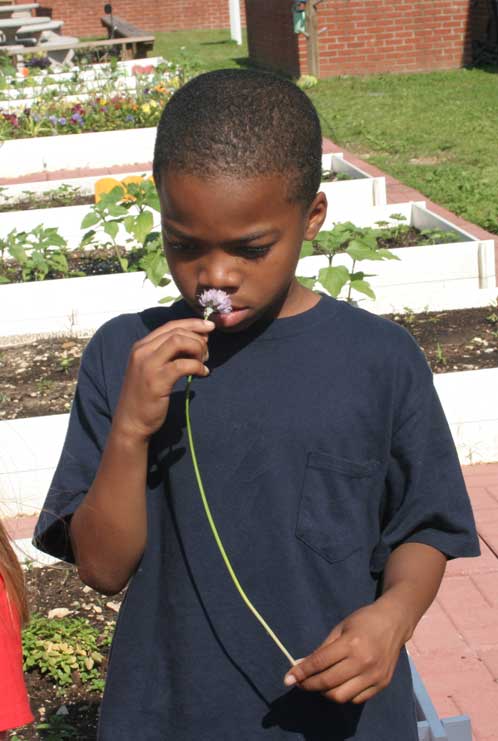
To visit Renee's Garden website, go to our website at Long Creek Herbs, and click on the Help Children- Seeds button.  You'll find the link to Renee's Seeds website, look around and see if you aren't tempted by her spring seed offerings. Then when you order, use our code (it's in the instructions you'll see), so that she can make a donation to this wonderful project. Then, you will know that more kids, like this boy, below, can experience for the first time in their life, the taste and smell of a chive blossom and learn how to fix a meal using fresh herbs and vegetables right out of the garden.

I'll be visiting the school again this week with friends from Bear Creek Farm. We'll work with the kids on taking rosemary cuttings and making rosemary cookies and I'll be posting more about that in a few days. I hope you'll consider ordering seed from Renee Shepherd, she has outstanding varieties you won't find anywhere else. And when you order, won't you do it through my website so the kids get credit? Thank you!
It's exciting to see kids learn about herbs and vegetables. This was his first ever smell and taste of a chive blossom!

1/06/2014

Dream Pillows and PTSD


As an author it has been gratifying to me over the past 16 years since this book came out, to see how Making Herbal Dream Pillows has influenced others. I have seen my formulas copied, reproduced, even plagiarized several times, while also bringing joy to others.

One of my readers who purchased my dream pillows kits told me how she takes my Kit for 50 to a nearby nursing home and uses it as an activity for the residents. “The residents love the fragrances of the herbs and flowers,” she said, “and the staff loves having me there because the residents all sleep so well that night.”

Another reader of my book, and customer of my bulk dream pillow blends, told me she had been hired by a pharmaceutical company. She is paid to go to their conferences where she sets up a booth and offers the attendees complimentary dream pillows, allowing them to choose between Restful Sleep, Pleasant Dreams, Romantic or Creative blends. (I wish I had thought of that; but of course I'm very glad for her).
Kit for 50 provides everything needed to make 50 dream pillows.

The most gratifying for me, however, is the lady who read my book and learned about how I had first learned my Restful Sleep formula from a pharmacist many years ago. I had blogged about how helpful that dream blend was for Vietnam Veterans who have flash-back nightmares and PTSD. She began making and giving away dream pillows to soldiers returning from Afghanistan and Iraq and reports great results. Recently she expanded the program, making it a non-profit organization, the American Heroes Sleep Project, in order to reach more returning soldiers and Veterans.
Restful Sleep pillow, 5 x 5 inches.

Her project now has its own website: americanheroessleepproject.org‎, and visitors to the site can purchase dream pillows (also known as sleep pillows) for themselves and a returning soldier who suffers from PTSD, as well.

To read more, my dream pillows blog is: jimsdreampillows.blogspot.com and my dream blends and dream pillows are on my website: LongCreekHerbs.com

Bulk dream blends and supplies.

Valentine's Day is coming up and dream pillows make excellent Valentines, too.

1/01/2014

Life and Flowers in the Winter Garden

Copyright 2014 Jim Long
People who don't garden regularly often think that once frost or a freeze hits, the garden is over and done. While that is true of many vegetable crops, there are a good many herbs that just keep on growing throughout the winter. Even though we've had 9 degrees a few times, 8 inches of snow and a bit of ice, you can see by the photos that follow, the garden is alive and well in January.
Comfrey, a valuable healing herb keeps its leaves for much of the winter months.
Yarrow, known for its amazing blood-stopping, wound healing properties looks festive covered with frost.
Henbit, weed to some, healthy greens herb for others, lacy with frost.
Garden sage looks dressed up when covered with heavy frost. The flavor is as good in winter as it is in summer.
If you think mint tastes cool and refreshing in summer, just taste it when it's frozen and edged with frost!
Frost flowers only "blossom" when the ground temperature is warmer than the air.
Moisture from the ground is forced upward through plant stems as the air temperature drops, creating fanciful frost flowers.
So delicate you can barely touch them, they disappear at the first kiss of sunlight.
So you see, there is lots of life in the garden in winter. Go out and look, and don't be afraid to taste the herbs, either. Happy New Year to all!