2/28/2011

More on the Kids' Garden

Melinda Smith, garden coordinator is explaining to Olee how the beds will be realigned.
My friend Olee Jobe, from Spring Fever Greenhouse in Republic, Missouri and I, drove down to Jonesboro, Arkansas a few days back. Olee had not seen the kids' garden and was interested, and he was donating potting soil and pots for their greenhouse. He was as inspired and impressed as I had thought he would be. It was a 4 hour drive for us each way to make the delivery, and well worth the trip.

Melinda was explaining the work in the garden coming up this week. The beds, currently done at an angle, (which she said looked like a good idea at the time 2 years ago) were going to be straightened. A local nursery is coming to realign the beds and add 2 additional ones, as well as put paving blocks around the beds to help keep the Bermuda grass somewhat at bay.
These are the beds that will be aligned along the pathway to make room for 2 more beds.
Pansies are in bloom in one of the beds and tulips are coming up in another. The nursery folks will transplant the bulbs, so nothing is lost. With the work progressing this week, the kids will be able to start planting some of the seed Renee's Garden Seed have donated.
This is the entrance to the school. Some of you have asked to see what it looks like. Melinda Smith said they have about 600 students in grades 1-6.
This is one corner of the science lab. In another corner there are several lizards, a snake, some birds, fish, plants and lots of books. I think Olee and I could have enjoyed sitting in class if we'd had such an interesting school room!
Several of the teachers stopped and thanked us for taking an interest in the kids' garden project. It was fun to see how the kids reacted to the teachers. I saw kids on numerous occasions come up and hug a teacher and say thank you for something. Olee said, and I heartily agreed, if we had ever had a teacher in our past who would hug a kid, we might have actually liked school when we were that age!
This is a recyle-robot. One of the classes had a contest with the kids to see what kind of projects they could come up, using all recycled materials. This was the winner. He's about 5 ft. tall, made totally of plastic bottles, milk cartons and similar materials. 
Would you like to help this amazing school? Here's a really simple, and totally painless way. Our friend, Renee Shepherd, owner of Renees.com (Renee's Garden Seeds), is making a wonderful offer. If you go to her website and order seed, and use this code when you order: FR556A, she will donate 25% of the price of the seed you order, to the Jonesboro School to Kitchen Garden Program. Isn't that great? So, go to her website and order some seed, being sure to use the FR556A coupon code.

We have been fans of Renee's seed collections for years. I love her selections of salad greens, squashes and herbs. She also offers something I really like, which is combining several varieties together. Like her Summer Scallop Trio, for example, which has 3 different colors of patty pan squashes in a packet, that way you don't have to buy several packets just to get 2 or 3 plants! And she tests her varieties first and only offers vegetables and herbs that will perform really well in your garden. She has very generously donated seed for the kids' garden this year and the kids and teachers will be planting in a few days. Meanwhile, order some seed for your garden and know you are also helping out this wonderful kids' garden project! (You can also go to our website and order from the link on our home page, using the same coupon code).

You can also follow the kids garden blog by going here.

I'm off to the Michigan Herb Associates annual conference, starting driving this weekend to give programs on March 9-10, then on to Toronto (Michigan or Ohio, I'm not sure) for programs on the 11th, driving home in time to repack and drive to Roundtop, Texas to speak at the annual Herbal Forum at Festival Hill (look at the link, you'll be impressed at the photos of this amazing garden!!) I'll be driving from the upper reaches of Michigan where it's going to be COOOOLD, then head south to sunny Texas where spring is already well underway.
Happy gardening!

2/20/2011

Jonesboro, AR Kids Garden

Those of you who have known me for any period of time will likely remember how excited I get when I hear about garden projects for schools. Several will remember, too, that I attended the very first Slow Foods conference in Turin, Italy, in 2005 and how pumped up I was for the entire slow foods, local foods movement, and remain so today. Food safety, including knowing what pesticides and chemicals we are putting into our bodies, is important. So is seeing that the money we spend on food goes to our neighbors and local community instead of to some giant corporation elsewhere. Add that to the fact that what you grow tastes better, costs less, and is better for you, then the local foods, school gardens projects make really good sense.
Outdoor demonstration area with part of the second garden in background
A couple of months back Melinda Smith from the Health, Wellness and Environmental Studies Magnet School, in Jonesboro, Arkansas contacted me, asking for suggestions about adding an herb garden to their school garden project. I was pleased to be asked and have more ideas than good sense.
Photos on the wall of last year's produce.
 I admit I was startled to find a school in Arkansas with a kids garden project. I love Arkansas, it's one of the best kept secrets in America (if everyone knew how beautiful the state is, there would be a lot more people and it would lose its attraction). But anyone who knows Arkansas, also knows it is not on the cutting edge of much of anything, especially not forward-thinking school projects devoted to health and wellness.
You can see the 10 raised beds (surrounded with awful Bermuda grass) and the little greenhouse in the background.
I had visited an amazing school garden project last summer in Dallas, and posted about it here. And I posted about the amazing Waldorf School outside Chicago this past fall. I've posted in past years about the kids garden projects in San Antonio and Philadelphia, too. But I was pleasantly surprised to find a school in eastern Arkansas with the foresight and creativity to be teaching kids about where their food comes from. I had to go see this school project!
That's Melinda Smith, Coordinator of the project, in the wonderful teaching kitchen.
Melinda Smith is the coordinator of the project, and she's one of those people who will not take no for an answer. Even when confronted with "that's impossible" she forges ahead and gathers people around her who can see a project move forward. She's received all of the questions about the project one might hear in any rural area, things like, "What's wrong with pizza and tater tots for school lunch?" "Why do kids need to learn to grow their own food?" and "Aren't there more important lessons than food?"
This is the trellis bed in the second garden area. The children grew vine plants last season.
Fortunately Melinda has a group of interested fellow-teachers who are dedicated to teaching children about health and wellness and realizing the food they eat has a profound bearing on every other aspect of their lives, including how they learn, how they grow and what they become.
This is part of the second courtyard, trellis garden in background. There are a few raised beds and lots and lots of Bermuda.
In an age when a high percentage of the population is overweight, and with a generation of people who think cooking from scratch involves opening a package for the microwave, the Health and Wellness Magnate School is a breath of fresh air.
One garden has chickens. The kids learn about where eggs come from and how to care for animals.
In only 2 short years, this unique Jonesboro school has generated enough grants to pay for several raised beds, a very small greenhouse and some seed, in previous years. They've used up the money and have spent it well. In spite of having to deal with an enclosed courtyard that is infested with the deadly Bermuda grass (deadly because it is so tenacious it comes up through plastic or paving - I've even seen it find its way through asphalt!) the kids held their first plant sale last year with plants they'd grown in the greenhouse. They produced vegetables and greens which they used in the impressive teaching kitchen lab.
Two homeless rabbits were given to the school and they are at home in one of the courtyards. Remember how Peter Rabbit's mother gave him chamomile tea when Peter ate too many carrots from father McGreggor's garden? These rabbits are well behaved and the children love them.
Renee Shepherd selects some of the best performing herbs and vegetables anywhere.
This year, the teachers want to move this garden ahead. Our friend, Renee Shepherd of Renees Garden has generously donated lots of seed for their beds and greenhouse. (If you don't know Renees' Seed, check out the link; she has some of the best mixtures of seeds, always outstanding performers in our gardens here). Our friends, Olee and Sharon Jobe at Spring Fever Greenhouse have donated several bags of potting soil and pots for the greenhouse.
One of the courtyards (there are 2) includes a raised bed with bulbs and roses.

The garden has its own blog where the teachers and kids post photos and updates on their garden. I urge you to go check it out, and sign up to Follow. (It's free, you don't have to do anything, just receive a note when they post new information, it's a great way to show your support). This is a project that has had a lot of "no" answers when they've asked for help. Many in their local community have been less than sympathetic or encouraging, so sign up as a follower and let them know you support what they are doing. I'll be posting more soon, but I wanted you to know about this really great garden project for kids.
Both the kids and the teachers made little flags with quotations they like, to decorate the outdoor demonstration area.
Keep in mind all these photos were taken in January but you can see the basics and by spring, this is going to be a beautiful garden again.
Happy gardening!

2/12/2011

Curry Tree, Kaffir Lime, Culantro

Thanks to everyone who entered the contest. One of our long time followers, Vangie, from Tokoyo had the 5th entry that was the correct answer - the angel was sitting next to a big clump of chives. I didn't expect anyone to recognize the variety, but for those who asked, it is 'Grolau,' a commercial and robust variety from Richters. Vangie's Valentine box was mailed to her mother who lives in Arkansas.

Here's what the garden looks like today (above). And  yesterday. And the day before. All week it's been frozen. It all looks pretty bleak.
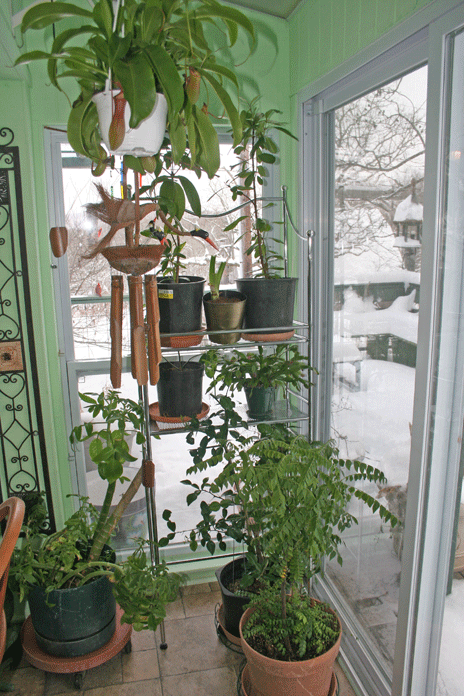
Some of the plants I'm growing: Allspice, Cinnamon, Kaffir Lime, Curry Tree and others.

But if I step back just a few feet from that view, here's what I can see, so I thought I'd write about some of the indoor plants I grow. I'm working on my Keynote presentation on Cutting Edge Plants that I'll be presenting to the Michigan Herb Associates conference in Michigan next month and will use some of the photos of the plants you see here.
Dancing Tea Plant (Codariocalys motorius X Ohashi leguminosae)
Some of the plants I grow are rather hard to come by, such as the Udorn Dancing Tea, above. This plant is known for its ability to move when sound is nearby. If you search YouTube for the words, "Dancing Tea" you'll find videos of a dancing tea with a radio nearby playing music. The top leaflets of the plant, "dance" in motion with music (or speaking). It's a medicinal tea plant from Thailand and is not the happiest of plants indoors but so far is hanging on. It likes part shade in the herb bed in summer.
 
This is an unusual bush variety of Piper nigrum from Thailand. Most black peppers are vines.
The black pepper plant has pepper berries about to start ripening. Yes, the same peppercorns you use when you sprinkle black pepper on your breakfast eggs.
True Curry Tree (Murraya koenigii) is used in Indian cooking and usually fried in hot oil.
I learned to appreciate the curry tree when I was in India a few years ago. It's essential to many Indian dishes.

Leaves of Kaffir Lime (Citrus hystrix) are used in cooking.
Kaffir lime isn't especially rare but it's also not a common houseplant. It will accept regular pruning and you can freeze the leaves for use later, although the fresh ones are best. I learned to use kaffir lime leaves in both cooked and uncooked dishes when at the Bopai Cooking School in Bangkok.
Allspice and Lemon Bay Rum
The allspice and bay rum will grow into small trees, about the size of a small redbud tree or a large lilac bush but I keep mine pruned to indoor size. In the summer they go outdoors on the deck. I like to crush the leaves and season dishes, especially desserts or whipped cream.
Culantro (Eryngium foetidum), also known as Vietnamese Coriander
You'll find the leaves of culantro next to a dish of pho in a Vietnamese restaurant. The plant is native to the Americas but it has found its way into many Asian countries' cuisines. It requires constant moisture from underneath and heavy shade. It's a biennial and you can see the seed clusters at the top so I'll save seed and replant. If you like cilantro, you will also like culantro, and like cilantro, is used fresh, not cooked.

There are quite a few more plants in another plant window, cinnamon, Okinawa spinach, lemongrass, and others, but you might find these interesting:
 I brought this Pin Cushion Plant (Nertera granadensi) back from Florida.
Money Tree (Pachira aquatica), once the source of paper for currency in Asian countries.
Every time I write about tropical or indoor plants in my newspaper columns I receive questions about keeping them insect free. Here's what I use, which is a kind of super fine oil spray. I take my plants outdoors about once a month and spray them all, stems, leaves, tops of soil and edges of plants, with the oil spray at the rate recommended on the label. The oil isn't toxic to humans or pets, is approved for organic uses, and simply smothers the insects and their eggs, including: white fly, scale insect, red spider and mealy bugs.
It's only available in quarts and will make about 12 gallons of spray (as I recall). There are 2 mail order sources that I know of: http://www.pestproducts.com/ultrafine.htm and Green Island Distributors.

Nearly all of my plants are seasoning or food plants, although the Money Tree and Pincushion Plants aren't. Here's one more, that as far as I know isn't edible, although it does eat other things itself, like flies and gnats.
This is in the Nepenthaceae plant family. The little pitchers should be kept half full of water to help attract insects.
So while the snow melts, I'm looking indoors at the greenery and life that will eventually move outdoors. I'm glad there are people who like snow and winter. White has never been a favorite color and falling down and sliding down the driveway on my backside has never been a favorite activity, either. Happy gardening!

2/06/2011

Valentine's Gift, Dream Pillows

Tuesday, Feb. 8
We have a winner! Evangela Potts, a friend from long ago in the former Joplin Herb Club, emailed this morning to say the angel is sitting beside a clump of chives. "Vangie" as we knew her, was just a kid back then. In fact (and I didn't expect anyone to actually know the variety) she said it looked larger than most chives, and she was right. It's a commercial variety from Richters' Herbs called 'Grolou' which is larger, more prolific and an outstanding variety. Thank you everyone for your guesses and for checking out our website. And for Vangie's being the 5th one, we'll be sending her the Valentine Special Dream Pillow. And for anyone who wants to order one, order today and we can get it in the mail in time for Valentine's Day.

Since February is the month of Valentines, roses and Dream Pillows, let's have a contest. This is for anyone who is currently a follower of this blog (or for anyone who reads it and hurries up and becomes a follower).

In case you don't know how, just click the Follow button above the list of followers, on the upper right side of the blog. You'll be given several options, including signing up for a Google account (which is easy and nothing bad happens to you when you do, it's free and you won't get spam or anything) or you can follow anonymously. Of course I'd rather you follow publicly so I can know who you are but maybe you're in hiding and need to be invisible. Then follow the next step which is to say which way email account you would like to be notified when I post a new message on this blog. That's it. It's simple, painless and easy. Hit the Follow button.


So, the contest. I'm doing it for a couple of reasons. Actually three. First, I want to draw attention to our completely, newly redesigned website, LongCreekHerbs.com, easier to use, new photos, a garden tour and you can even download free photos of our garden for your computer desktop. We're proud of the nice changes and hope you will be, too.


Second, I want to promote our Valentine's Day Special. It's a Romantic Dream Pillow, with my Dream Pillows and Love Potions book, mailed to you or anyone you choose in a box stuffed with fragrant, dried roses and rose petals. It's a unique, thoughtful Valentine gift for your someone special. It's $14.95 plus shipping and you can see it on our Dream Pillows page.

And my third reason is to get more people who already read my blog, to sign up to Follow it.


This open to anyone who is a follower of this blog. The contest?

Take the Virtual Tour of our herb garden from the home page of our website. Send me the answer to this question: What is the plant the terra cotta angel is sitting beside?

Email the answer to me at Longcreekherbs@yahoo.com. The 5th email with the right answer wins.

And what is the prize? It is our Valentine's Day Special, mailed to you or someone you choose. There's still time we don't have a 5th email with a right answer yet.


1/30/2011

Walls and Walls of Plants

Our friend Jim Martin posted photos of his very creative plant walls on his blog, Compost in My Shoes. To see how he turned a couple of sheets of marine-grade plywood into a very sharp outdoor wall of plants, check his blog post, here. I believe Jim could turn a turnip into a work of art!

I saw some amazing plant walls at the Tropical Plant Industry Expo in Ft. Lauderdale last weekend. The variety of plants used was pretty amazing, from bromeliads to ferns and begonias. Once again I apologize for the photos. I was trying out my new Samsung Incredible smartphone. I'd opted for this instead of the iPhone, which gets great reviews for its photos. The Samsung takes consistently awful photos. Next time, I'll use my real camera.

This is obviously a trade show display, but it's an interesting way to showcase all the colors of the anthuriums the grower offers.
The wall above is made up of different varieties of bromeliads. If you're not familiar with these plants, their native habitat is high up in trees, others out on limbs or trunks. Their roots are primarily anchors to keep them attached to tree bark. They rely on rainfall that trickles into the center of the plant for their moisture. They are a tropical plant you can grow as a houseplant, and no reason they can't be grown on a moss-covered chicken wire fence or wall, as you see them above.

The manequin (doesn't everyone have an extra manequin or two in their garage??) has a mesh wrap with peat moss attached and planted with foliage and young palm seedlings.

One of the fun new products on the market is the Wally Pocket. This is one of the Wally Pocket guys standing beside their award for outstanding new product the Plant Expo awarded. The pockets (that's one he's standing beside, in blue, the one beneath it is tan) are meant to be attached to a wall or garden fence, then planted. They're made of recycled, shredded plastic soda bottles and feel like felt, or heavy wool. They breathe, allow water to escape, but are virtually indestructible. You can grow everything from tomatoes to herbs, salad greens to bush squash. I'll be trialing some in our garden here this year. If you are interested in these, here's more information.
The Wally Pockets come in a variety of colors and sizes. They make it easy to have a wall garden.
Another new product showcased at the Tropical Plant Show were these very interesting lighted plant containers from Illuminated Pots. The container is plain translucent white, a low watt flourescent bulb and fixture is underneath, and each planter comes with a 4 color disks that go over the bulb. This would make an impressive way to light up your summer patio.

My drive back from Florida these past 2 days went well. I stopped at almost every thrift shop and junk store along the way. It wasn't warm in Florida - I think I mentioned it got down to just above freezing in south central Florida one night. People were wearing hefty coats on the beaches. But yesterday, driving back from Little Rock to home, it was 72 degrees F. all the way and I had the windows rolled down. Now why couldn't Florida have been that nice? But we are predicted to have zero here in the Ozarks by Thursday and snow and sleet on the way. One nice day of spring will have to do for now. Happy gardening!
1/22/2011

Segue, More Ice

The word, segue, comes from Italian, and literally means, follow. So this seems a good transition, a good segue, to follow ice sculptures in the previous post, with more ice.
I'm in central Florida (where it's 20 degrees tonight, which makes neither the locals nor us tourists very happy). I visited the Tropical Plant Industry Exposition in Ft. Lauderdale, along with a Garden Writers of America Regional meeting, held at the Expo. The tropical plant Expo is a large trade show with all kinds of wholesale plant people from across Florida and lots from the East and West Coasts, as well. It's where people come to see what's new to the industry this year, and where wholesalers get new accounts for their plants. The ice sculpture, above, was part of a booth promoting the Just Add Ice Orchids, which you may have noticed in stores already. Their sales gimmick is to point out that orchids are tough plants and easy to grow. So easy, in fact, that all you have to do is add 3 or 4 ice cubes on the top of the pot once a week!
Two large, healthy orchids, frozen in solid ice, as part of the display. No, they won't survive when thawed out.

They had frozen a couple of large orchids in ice as part of their display, which I thought was going a bit overboard, but it was eye catching. Our long time acquaintance, P. Allen Smith was there to promote the orchids and sign some books. I think he's the official spokesperson for the Just Add Ice series. Chris Bytes was one of our speakers at the Garden Writers' Regional, speaking on using videos for business promotion.
P. Allen Smith with Chris Bytes, Editor of GrowerTalks Magazine and Ball Red Book. I did some writing for Chris a few years back in the Red Book.

The show has always been palms, blooming plants, planters, soil, bamboo... all those plants you think of as tropical. And they were here, also, but what surprised even the long time booth folks, was how fast orchids have become popular. In fact, the 2 unintentional themes of this year's show, was plant walls and orchids. (More about plant walls later).
There were orchids in all sizes and price ranges
The trade show had 22 rows across the auditorium, with about 12 or 15 booths on each side of the 22 aisles; that's a lot of plant displays! But everyone was talking about how the orchids had taken over this year. And the one everyone wanted was a new blue one. (For comparison, the orchids above retail for about $12; the fancy blue ones were going for $40).
But even this one wasn't the bluest of the blues.
This one, below, won one of the prizes for best in show this year.

The nursery producing these orchids (below) also won an award for best in show. Their orchids (sorry, I'm not up on my orchid varieties - remember, I grow plants I can eat, were spectacular waterfall orchids.
You can't tell it from this photo, but this is a 12 ft high wall of orchids!
My apologies for the poor photo quality. I am trying out my new smartphone's photo capabilities; I'm disappointed in the quality. However, hopefully you can see what amazingly long stems of flowers these orchids have, many of them 2 ft long or more!
The anthurium runway. The grower is from Germany and he had some spectacular plants.
There was an anthurium grower at the show, showing off new color introductions in anthuriums. Lots of the booths try to put on a big splash to draw attention and sell their plants. Bringing P. Allen Smith, for example. This grower hired models and had a runway, lights and music, putting on a show with the girls showcasing bouquets of the anthuriums.
Sorry one more time, for the poor photo quality.

And the second big theme at the show (and apparently at other plant shows this year) is plant walls. Here are a couple of previews of more to come.
I'll stay in Florida for a few more days, hopefully finding somewhere that is warmer than the weather in Bradenton is tonight. Hope it's warm where you are, too.